3. Why Did You Not Take a Volume Reading for the Butane Gas at 0 Ââ°c?
| |||
| |||
| Names | |||
|---|---|---|---|
| Preferred IUPAC name Butane[3] | |||
| Systematic IUPAC name Tetracarbane (never recommended[3]) | |||
| Other names Butyl hydride;[1] Quartane;[2] Refrigerant 3-xi-0 | |||
| Identifiers | |||
| CAS Number |
| ||
| 3D model (JSmol) |
| ||
| Beilstein Reference | 969129 | ||
| ChEBI |
| ||
| ChEMBL |
| ||
| ChemSpider |
| ||
| ECHA InfoCard | 100.003.136  | ||
| EC Number |
| ||
| E number | E943a (glazing agents, ...) | ||
| Gmelin Reference | 1148 | ||
| KEGG |
| ||
| MeSH | butane | ||
| PubChem CID |
| ||
| RTECS number |
| ||
| UNII |
| ||
| Un number | 1011 | ||
| CompTox Dashboard (EPA) |
| ||
| InChI
| |||
| SMILES
| |||
| Properties | |||
| Chemical formula | C 4 H 10 | ||
| Molar mass | 58.124 g·mol−1 | ||
| Appearance | Colorless gas | ||
| Odor | Gasoline-similar or natural gas-like[1] | ||
| Density | 2.48 kg/m3 (at 15 °C (59 °F)) | ||
| Melting point | −140 to −134 °C; −220 to −209 °F; 133 to 139 K | ||
| Humid point | −1 to 1 °C; thirty to 34 °F; 272 to 274 K | ||
| Solubility in water | 61 mg/50 (at xx °C (68 °F)) | ||
| log P | 2.745 | ||
| Vapor pressure | ~170 kPa at 283 Yard [iv] | ||
| Henry's police | 11 nmol Pa−1 kg−i | ||
| Conjugate acid | Butanium | ||
| Magnetic susceptibility (χ) | −57.4·x−half-dozen cm3/mol | ||
| Thermochemistry | |||
| Heat capacity (C) | 98.49 J/(K·mol) | ||
| Std enthalpy of | −126.3–−124.ix kJ/mol | ||
| Std enthalpy of | −two.8781–−2.8769 MJ/mol | ||
| Hazards[5] | |||
| GHS labelling: | |||
| Pictograms |   | ||
| Bespeak word | Danger | ||
| Hazard statements | H220 | ||
| Precautionary statements | P210 | ||
| NFPA 704 (fire diamond) | 1 four 0 SA | ||
| Wink betoken | −60 °C (−76 °F; 213 Grand) | ||
| Autoignition | 405 °C (761 °F; 678 K) | ||
| Explosive limits | 1.8–8.4% | ||
| NIOSH (Usa health exposure limits): | |||
| PEL (Permissible) | none[1] | ||
| REL (Recommended) | TWA 800 ppm (1900 mg/m3)[1] | ||
| IDLH (Immediate danger) | 1600 ppm[1] | ||
| Related compounds | |||
| Related alkanes |
| ||
| Related compounds | Perfluorobutane | ||
| Supplementary information folio | |||
| Butane (data page) | |||
| Except where otherwise noted, data are given for materials in their standard state (at 25 °C [77 °F], 100 kPa). | |||
 Yverify (what is Yverify (what is  Y Y  North ?) North ?) | |||
| Infobox references | |||



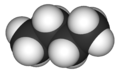

Butane () or northward-butane is an alkane with the formula CfourHx. Butane is a gas at room temperature and atmospheric pressure. Butane is a highly flammable, colorless, hands liquefied gas that chop-chop vaporizes at room temperature. The proper noun butane comes from the roots simply- (from butyric acrid, named after the Greek discussion for butter) and -ane. It was discovered by the chemist Edward Frankland in 1849.[vi] It was found dissolved in crude petroleum in 1864 past Edmund Ronalds, who was the get-go to draw its properties.[7] [8]
Butane is ane of a group of liquefied petroleum gases (LP gases). The others include propane, propylene, butadiene, butylene, isobutylene, and mixtures thereof. Butane has a lower energy density simply burns more cleanly than gasoline and coal.
Butane Density [edit]
The density of butane is highly dependent on temperature and pressure in the reservoir.[9] For example, the density of liquid phase is 571.viii±1 kg/thousandthree (for pressures up to 2MPa and tempereature 27±0.2 °C), while the density of liquid butane is 625.5±0.7 kg/m3 (for pressures up to 2MPa and temperature -13±0.2 °C).

Propane & butane density information [9]
History [edit]
![[icon]](https://upload.wikimedia.org/wikipedia/commons/thumb/1/1c/Wiki_letter_w_cropped.svg/20px-Wiki_letter_w_cropped.svg.png) | This section needs expansion. Y'all can assistance by adding to it. (June 2021) |
Butane was discovered by the chemist Edward Frankland in 1849. It was found dissolved in crude petroleum in 1864 by Edmund Ronalds, who was the first to draw its properties.
Isomers [edit]
| Common proper noun | normal butane unbranched butane n-butane | isobutane i-butane |
| IUPAC proper name | butane | methylpropane |
| Molecular diagram |  |  |
| Skeletal diagram |  |  |
Rotation about the fundamental C−C bond produces two different conformations (trans and gauche) for northward-butane.[10]
Reactions [edit]

When oxygen is plentiful, butane burns to grade carbon dioxide and water vapor; when oxygen is limited, carbon (soot) or carbon monoxide may also be formed. Butane is denser than air.
When there is sufficient oxygen:
- two C4H10 + 13 O2 → 8 CO2 + ten H2O
When oxygen is limited:
- 2 C4Hten + 9 O2 → 8 CO + 10 HtwoO
By weight, butane contains about 49.5 MJ/kg (13.viii kWh/kg; 22.5 MJ/lb; 21,300 Btu/lb) or by liquid volume 29.7 megajoules per liter (8.3 kWh/l; 112 MJ/U.S. gal; 107,000 Btu/U.S. gal).
The maximum adiabatic flame temperature of butane with air is 2,243 Grand (1,970 °C; 3,578 °F).
n-Butane is the feedstock for DuPont's catalytic process for the training of maleic anhydride:
- 2 CHiiiCHiiCH2CH3 + 7 Otwo → 2 CiiH2(CO)2O + 8 HiiO
due north-Butane, like all hydrocarbons, undergoes gratis radical chlorination providing both 1-chloro- and ii-chlorobutanes, as well as more highly chlorinated derivatives. The relative rates of the chlorination is partially explained by the differing bond dissociation energies, 425 and 411 kJ/mol for the two types of C-H bonds.
Uses [edit]
Normal butane can be used for gasoline blending, every bit a fuel gas, fragrance extraction solvent, either alone or in a mixture with propane, and every bit a feedstock for the manufacture of ethylene and butadiene, a key ingredient of synthetic rubber. Isobutane is primarily used by refineries to enhance (increase) the octane number of motor gasoline.[11] [12] [13] [14]
For gasoline blending, n-butane is the main component for Reid Vapor Pressure (RVP) manipulation. Winter fuels require much higher vapor pressure level in order for the engine to kickoff up, refineries tend to blend more butane into the final product to raise the (RVP).[15] due north-Butane also has a relatively high blending research octane number and motor octane number, which is rated at 93 and 92 respectively.[xvi]
When blended with propane and other hydrocarbons, it may exist referred to commercially as LPG, for liquefied petroleum gas. It is used as a petrol component, as a feedstock for the production of base petrochemicals in steam cracking, as fuel for cigarette lighters and as a propellant in aerosol sprays such as deodorants.[17]
Very pure forms of butane, peculiarly isobutane, can be used as refrigerants and take largely replaced the ozone-layer-depleting halomethanes, for instance in household refrigerators and freezers. The system operating pressure for butane is lower than for the halomethanes, such as R-12, and so R-12 systems such as in automotive air conditioning systems, when converted to pure butane will not function optimally and therefore a mix of isobutane and propane is used to give cooling system performance comparable to R-12.
Butane is likewise used every bit lighter fuel for a common lighter or butane torch and is sold bottled as a fuel for cooking, barbecues and camping stoves. The global market for butane canisters is dominated past S Korean manufacturers.[18]
As fuel, it is often mixed with small amounts of hydrogen sulfide and mercaptans which will give the unburned gas an offensive smell easily detected by the human being nose. In this way, butane leaks tin easily be identified. While hydrogen sulfide and mercaptans are toxic, they are nowadays in levels so depression that suffocation and fire take chances by the butane becomes a concern far before toxicity.[19] [20] Virtually commercially available butane besides contains a certain amount of contaminant oil which tin can exist removed through filtration but which will otherwise leave a deposit at the point of ignition and may eventually block the uniform flow of gas.[21] The butane used in fragrance extraction does not contain these contaminants[22] and butane gases can cause gas explosions in poorly ventilated areas if leaks go unnoticed and are ignited by spark or flame.[5] Butane in its purest grade is also used every bit a solvent in the industrial extraction of cannabis oils.
-
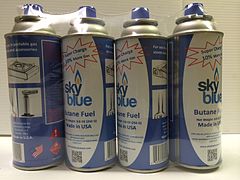
Butane fuel canisters for use in camping stoves
-
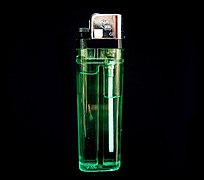
Butane lighter, showing liquid butane reservoir
-
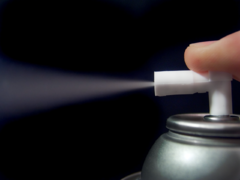
An aerosol spray tin, which may be using butane as a propellant
-

Butane gas cylinder used for cooking
Effects and health issues [edit]
Inhalation of butane can cause euphoria, drowsiness, unconsciousness, asphyxia, cardiac arrhythmia, fluctuations in blood pressure and temporary memory loss, when abused direct from a highly pressurized container, and can result in death from asphyxiation and ventricular fibrillation. It enters the blood supply and within seconds produces intoxication.[23] Butane is the most ordinarily abused volatile substance in the Great britain, and was the cause of 52% of solvent related deaths in 2000.[24] By spraying butane straight into the throat, the jet of fluid can cool chop-chop to −20 °C (−four °F) past expansion, causing prolonged laryngospasm.[25] "Sudden sniffer's death" syndrome, commencement described past Bass in 1970,[26] is the nearly mutual single cause of solvent related decease, resulting in 55% of known fatal cases.[25]
See too [edit]
- Isobutane
- Cyclobutane
- Dimethyl ether
- Volatile substance abuse
- Butane (information page)
- Butanone
- n-Butanol
- Liquefied petroleum gas
- Industrial gas
- Butane torch
- Gas explosions
References [edit]
- ^ a b c d e NIOSH Pocket Guide to Chemical Hazards. "#0068". National Plant for Occupational Safety and Health (NIOSH).
- ^ Hofmann, August Wilhelm Von (1 January 1867). "I. On the action of trichloride of phosphorus on the salts of the effluvious monamines". Proceedings of the Royal Society of London. 15: 54–62. doi:10.1098/rspl.1866.0018. S2CID 98496840.
- ^ a b "Front Matter". Nomenclature of Organic Chemical science : IUPAC Recommendations and Preferred Names 2013 (Blue Volume). Cambridge: The Purple Society of Chemical science. 2014. p. 4. doi:x.1039/9781849733069-FP001. ISBN978-0-85404-182-4.
Similarly, the retained names 'ethane', 'propane', and 'butane' were never replaced by systematic names 'dicarbane', 'tricarbane', and 'tetracarbane' equally recommended for analogues of silane, 'disilane'; phosphane, 'triphosphane'; and sulfane, 'tetrasulfane'.
- ^ W. B. Kay (1940). "Pressure level-Volume-Temperature Relations for n-Butane". Industrial & Technology Chemistry. 32 (3): 358–360. doi:ten.1021/ie50363a016.
- ^ a b "Safe Data Sail, Material Name: North-Butane" (PDF). USA: Matheson Tri-Gas Incorporated. v February 2011. Archived from the original (PDF) on 1 October 2011. Retrieved 11 December 2011.
- ^ Russel, Colin A. (20 March 2009). "Frankland – the Offset Organometallic Chemist" (PDF). The Sixth Wheeler Lecture. Royal Society of Chemistry. Archived from the original on 17 April 2017.
{{cite journal}}: CS1 maint: unfit URL (link) - ^ Watts, H.; Muir, M. G. P.; Morley, H. F. (1894). Watts' Dictionary of Chemistry. Watts' Lexicon of Chemistry. Vol. iv. Longmans, Green. p. 385.
- ^ Maybery, C. F. (1896). "On the Composition of the Ohio and Canadian Sulphur Petroleums". Proceedings of the American Academy of Arts and Sciences. 31: 1–66. doi:10.2307/20020618. JSTOR 20020618.
- ^ a b Zivenko, Oleksiy (2019). "LPG ACCOUNTING SPECIFICITY DURING ITS STORAGE AND TRANSPORTATION". Measuring Equipment and Metrology. lxxx (iii): 21–27. doi:10.23939/istcmtm2019.03.021. ISSN 0368-6418.
- ^ Roman M. Balabin (2009). "Enthalpy Departure betwixt Conformations of Normal Alkanes: Raman Spectroscopy Report of n-Pentane and n-Butane". J. Phys. Chem. A. 113 (6): 1012–nine. Bibcode:2009JPCA..113.1012B. doi:10.1021/jp809639s. PMID 19152252.
- ^ MarkWest Free energy Partners, Fifty.P. Course x-K. Sec.gov.
- ^ Copano Free energy, L.L.C. Form 10-Thou. Sec.gov. Retrieved on 2012-12-03.
- ^ Targa Resources Partners LP Form10-thou. Sec.gov. Retrieved on 2012-12-03.
- ^ Crosstex Free energy, Fifty.P. FORM 10-K. Sec.gov.
- ^ Maurice Stewart, Ken Arnold. "Reid Vapour Pressure". Scientific discipline Directly. Archived from the original on 13 June 2020.
- ^ Jechura, John. "octane rating" (PDF). Colorado School of Mines. Archived (PDF) from the original on 1 May 2015.
- ^ A Primer on Gasoline Blending. An EPRINC Conference Memorandum.
- ^ "Entrepreneur overcame hardships of Chinese prison house". houstonchronicle.com. 21 June 2016. Retrieved 20 September 2018.
- ^ Gresham, Chip (16 November 2019). "Hydrogen Sulfide Toxicity: Practice Essentials, Pathophysiology, Etiology". Medscape Reference . Retrieved 22 March 2021.
- ^ Commission on Acute Exposure Guideline Levels; Committee on Toxicology; Board on Environmental Studies and Toxicology; Division on Earth and Life Studies; National Enquiry Council (26 September 2013). two. Methyl Mercaptan Astute Exposure Guideline Levels. NCBI Bookshelf. National Academies Printing (Usa).
{{cite book}}: CS1 maint: multiple names: authors listing (link) - ^ "BHO Mystery Oil". Skunk Pharm Research. 26 August 2013. Retrieved five December 2019.
- ^ "Final Written report of the Condom Assessment of Isobutane, Isopentane, n-Butane, and Propane". Journal of the American College of Toxicology. SAGE Publications. 1 (iv): 127–142. 1982. doi:10.3109/10915818209021266. ISSN 0730-0913. S2CID 208503534.
- ^ "Neurotoxic Effects from Butane Gas". thcfarmer.com. 19 December 2009. Retrieved 3 October 2016.
- ^ Field-Smith M., Banal J. Thousand., Taylor J. C. et al. "Trends in decease Associated with Abuse of Volatile Substances 1971–2004" (PDF). Department of Public Health Sciences. London: St George'south Medical School. Archived from the original (PDF) on 27 March 2007.
{{cite spider web}}: CS1 maint: uses authors parameter (link) - ^ a b Ramsey J., Anderson H. R., Bloor Grand. et al. (1989). "An introduction to the practice, prevalence and chemical toxicology of volatile substance abuse". Hum Toxicol. viii (four): 261–269. doi:10.1177/096032718900800403. PMID 2777265. S2CID 19617950.
{{cite journal}}: CS1 maint: uses authors parameter (link) - ^ Bass Chiliad. (1970). "Sudden sniffing decease". JAMA. 212 (12): 2075–2079. doi:x.1001/jama.1970.03170250031004. PMID 5467774.
External links [edit]
 | Wikimedia Commons has media related to Butane. |
- International Chemical Safe Card 0232
- NIOSH Pocket Guide to Chemical Hazards
Source: https://en.wikipedia.org/wiki/Butane
0 Response to "3. Why Did You Not Take a Volume Reading for the Butane Gas at 0 Ââ°c?"
Post a Comment